
Meet the Makers, ep 3. Selina L - Knitwear Repair Specialist
Interview by Noa Barak, The Seam, August 2026.
Selina Latour grew up in Montreal and now works from her London studio, where jumpers, blankets and half-mended cardigans sit in neat piles waiting for her needle. A specialist in knitwear repair, she trained in fine arts with a focus on textile processes before turning her hand almost entirely to darning - the quiet, painstaking art of rebuilding a knit stitch by stitch. Her studio is calm and precise, the opposite of the throwaway culture she's spent her career pushing back against.

Noa: You mentioned something powerful before we even started recording - that fast fashion needs to end, and that repair is part of the answer. Can you say more about that?
Selina: I really believe it. We've lost a lot of the basic, essential repair skills our grandparents had as a matter of course. If we go back to caring for our things - actually mending them instead of replacing them - I think it changes more than our wardrobes. It makes us more careful people, generally. More attentive in our relationships, too. It's all connected.
Noa: How did you first get into knitwear repair specifically?
Selina: It came out of years of working with textiles. I majored in fine arts, but I was always drawn to process - how something is actually made, thread by thread. Knitwear repair let me combine that technical curiosity with something genuinely useful.

Noa: For anyone who's never seen it done, what does the repair itself actually involve?
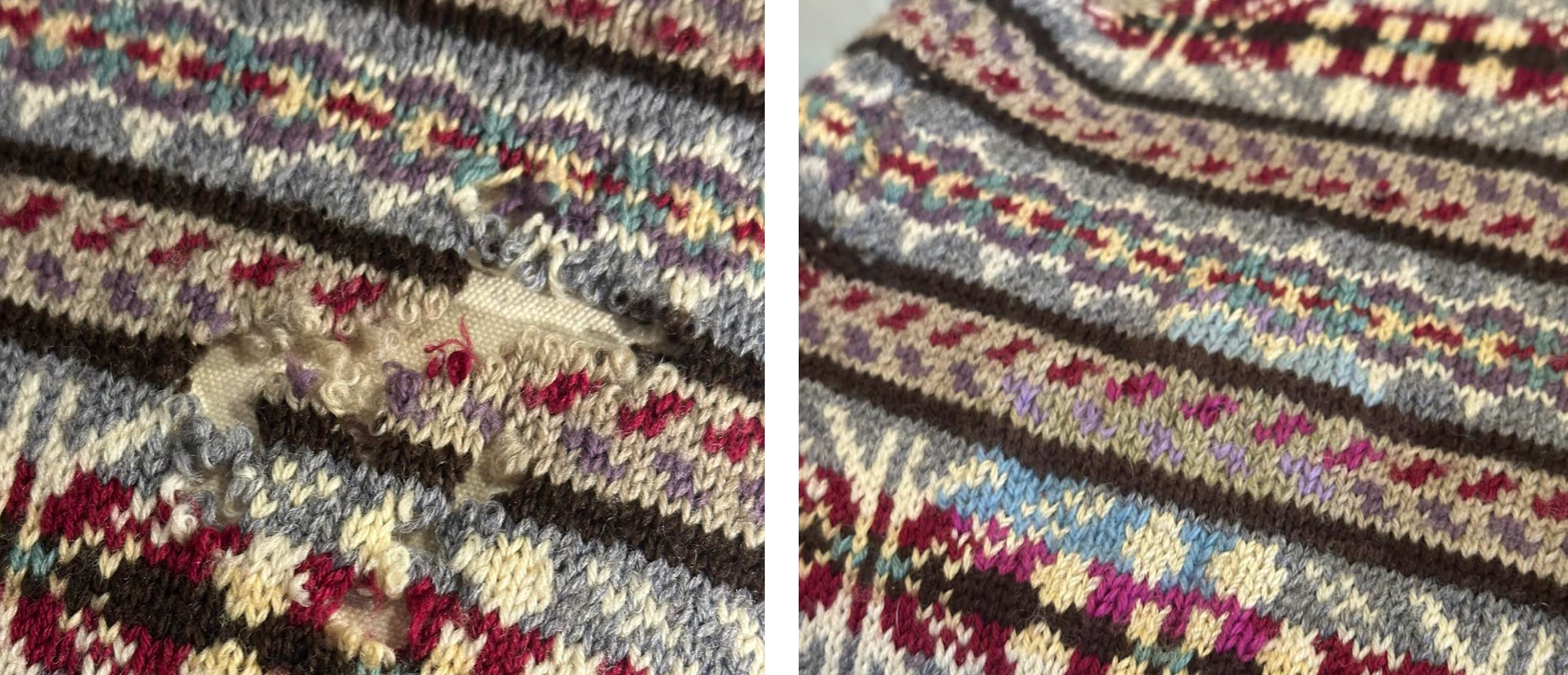
Selina: Mostly it's a technique called Swiss darning - sometimes called duplicate stitch, or Dutch darning. You're essentially recreating the knit loops themselves with a needle and thread, so the repair sits inside the structure of the garment rather than on top of it. When the knit is too fine for that, I'll use woven darning instead, which builds the repair a little differently. Most of what comes to me is straightforward — a moth hole or two, needing a bit of Swiss darning to put right.
Noa: What's the most memorable piece you've worked on?
Selina: A blanket that meant, honestly, everything to the person who owned it. It was full of holes — really, really worn through — and it would have taken most people about ten seconds to decide it belonged in the bin. But the owner was completely committed to keeping it. It took hours and hours and hours. That kind of dedication from a client is rare, and it's a privilege to match it.
Noa: Do you have a favourite type of repair to work on?
Selina: Visible mending, always. That's where I get to be creative — doing colour exploration instead of colour matching, letting the repair sit on the surface as something intentional rather than something hidden. It's the difference between disguising damage and giving it a new life.
Noa: And on the other end of the spectrum — how invisible can a repair actually be?
Selina: Genuinely invisible, if that's what the piece calls for. I have finished repairs I can no longer find myself, even looking for them. It still surprises me, and I do this for a living.

Noa: What's the longest you've ever spent on a single piece?
Selina: Somewhere around 40 hours, on a repair that mattered enormously to its owner. That's not unusual for the kind of pieces people bring me - the ones worth that many hours are almost always the ones with a story attached.
Noa: If you could get one thing across to people about caring for their knitwear, what would it be?
Selina: That it's almost always worth repairing. A moth hole isn't the end of a jumper's life — it's just a hole. Most damage is fixable, and fixing it is a small, quiet way of saying a thing still matters to you.
Selina's studio is proof that repair doesn't have to mean compromise — a mend can be as considered, and sometimes as beautiful, as the garment itself. Whether she's rebuilding a knit loop by loop until it disappears, or turning a moth hole into a small, deliberate flourish of colour, her work makes the same quiet argument: that caring for what we already have is a craft worth keeping alive.
If you'd like to work with Selina simply add her name when prompted during your initial enquiry on The Seam.
Her passion for sustainable knitwear repair really shines through. It would be neat to dive deeper into the tools she uses fnaf 2 maybe a future post on that? Thanks for highlighting such an important aspect of fashion sustainability! Keep it up!
Exploring Platforms: Why Variety, Usability, and Trust Matter
I’ve been exploring different online platforms lately and noticed how much the overall experience depends on variety and usability. I usually check out different options because having access to a wide range of features in one place makes it easier to compare services and find what actually suits my needs while keeping everything simple to navigate. What I like most is when a platform combines useful tools, clear information, and convenient features without making the interface feel overloaded. It’s also important that payments are smooth and customer support is responsive, since these details really build trust. In my opinion, a good online platform is not just about the number of available features,…
What's the longest you've ever spent on a single piece? @granny 1
Wordle Hint Today helps daily players find a better direction when a puzzle becomes difficult. The available clues can make confusing letter combinations easier to understand. Players can use only the information they need before returning to the puzzle. A helpful hint may turn an uncertain guess into a much stronger choice. The experience keeps the satisfaction of solving the word while reducing unnecessary frustration.