
A Question of Value: The Sentimental Value of Everyday Things
Updated: Jun 12
Last week, we asked a simple question: What item is worth the least but means the most to you?
The responses that landed in our inbox weren't stories about expensive jewellery, family heirlooms or collector's items. They were stories about objects whose value had little to do with what they cost, and everything to do with the lives attached to them.
For Annie, it's "the old hospital beret my grandmother wore when working for the Red Cross."
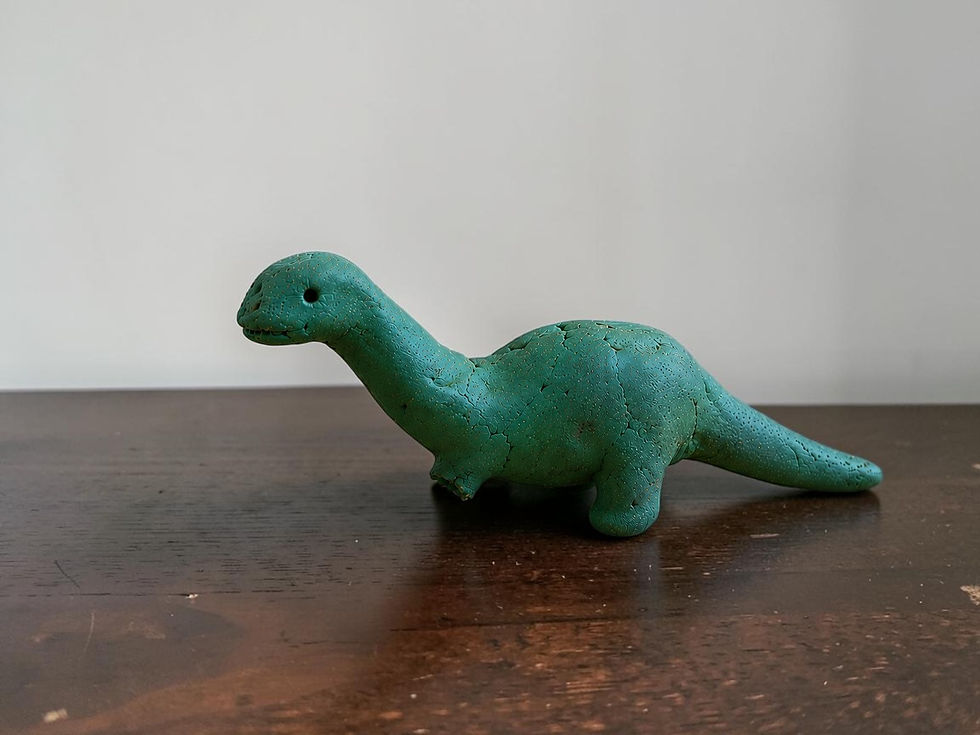
Laura treasures "a clay dinosaur my son made at primary school. One of the leg fell off years ago, but it still sits on my desk."
One reader keeps a free stuffed rabbit toy from a Happy Meal—26 years later. Another told us about the embroidered handkerchiefs made by her mother. And Samuel told us they would never part with "a football scarf I got at my first match with my grandad."
When we asked our founder, Layla, the answer was a pair of linen trousers she made with her grandmother, a dressmaker and inspiration behind The Seam. The trousers themselves are unremarkable. What remains invaluable is the memory of sitting beside her nan, learning through making.

Again and again, the stories returned to the same theme: ordinary things carrying extraordinary meaning. Louise wrote about a wooden spoon that belonged to her mother:
"The spoon is something I use almost every day and it represents the love of food and cooking that Mum gave to me."
Mark's treasured possession is a scratched enamel mug that belonged to his father:
"It's chipped, stained and completely ordinary, but it's still the mug I reach for every morning."

And then there was Monica's story.
Her most treasured item is a T-shirt that belonged to her late mother:
"The t-shirt is a relic from a different time, worn so often by her and now me, the once 100% cotton jersey fabric has worn thin enough to be fairly sheer."
For Monica, the T-shirt represents something deeper than the garment itself:
"This t-shirt is a piece of her before she became my mom, before illness and cognitive impairment defined her life. It was a t-shirt she wore when she was young, free and happy…I'll keep it forever."
Reading through these responses, we were reminded that memory rarely lives where we expect it to. It settles into the folds of a T-shirt, the handle of a wooden spoon, the worn fabric of a football scarf.
The objects themselves are often ordinary. What makes them irreplaceable is that they have absorbed a life: a parent making dinner, a grandfather at a first football match, a child proudly carrying home a clay dinosaur from school.
Their sentimental value far outweighs their monetary worth. A worn T-shirt, a chipped mug or a handmade dinosaur may have little financial value, but the memories they hold make them priceless to the people who own them.

We often think of possessions as things we own. But the stories shared with us suggest the opposite. The possessions we treasure most are the ones that, in some small way, come to possess us — binding us to our histories, our families and the versions of ourselves we don't want to forget.
At The Seam, we spend every day helping people care for the things they love. Reading these stories reminded us that behind every repair is often something much bigger than the item itself: a memory, a relationship, a moment in time. The sentimental value of an item is often what makes it worth preserving.
Thank you to everyone who shared their story with us.
Encontrar información clara sobre la Lotería Nacional resulta muy útil para quienes acostumbran consultar los sorteos. Una página bien organizada permite revisar los resultados con facilidad, comparar números de diferentes fechas y mantenerse al tanto de las publicaciones más recientes sin tener que buscar información en varias fuentes.
This piece provides a fresh and compelling take on the subject. I appreciate the depth of research and clarity in your writing. just be patient
The piece warms the heart by reminding us that even an old hat or a clay dinosaur with a broken limb may be valuable. Like run 3, you can choose from innumerable characters with unique powers, but the default "Grey Alien"—simple and free but a consistent friend through so many challenges—is the one you bond with most. Even basic objects are worth something—the memories we've shared with them over the years.
Spent a few minutes with eggy car today and kept trying to beat my previous distance. The uneven roads make every jump feel a little risky.
The physics are what caught me off guard with Drive Mad. You really have to slow down before some of those awkward jumps.